ANCIENT WISDOM FOR MODERN TIMES
author - gayathri sathiamoorthy
Picture Illustration by: Vasudha Thirumala Kumara
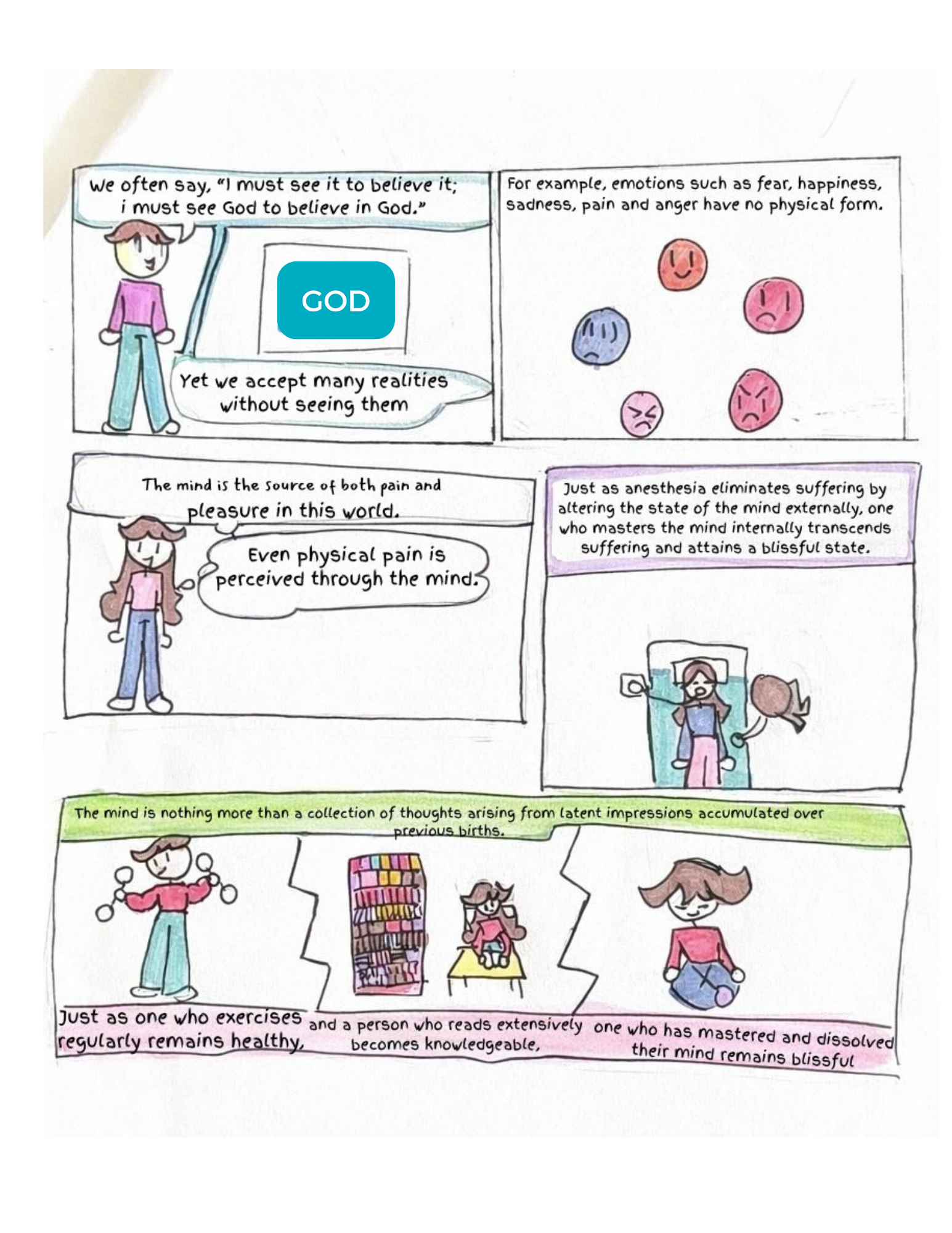
The Vanishing Act!The paradox is that the mind "disappears" the moment you look for its source.We often say, “I have to see it in order to believe it, like I must see God to believe in God.” Yet there are many realities we readily accept without seeing them. Emotions such as fear, happiness, sadness, pain, and anger have no physical form; they are experienced only through the mind. Because we have directly experienced these feelings, we are able to acknowledge and relate to them. However, God is beyond the mind and cannot be experienced through mental processes alone.
The mind is the source of both pleasure and pain in this world. It is also through the mind that we conceive of liberation from the endless cycle of birth and death. Even physical pain is perceived through the mind. Under anesthesia, pain does not cease to exist; rather, the mind is disconnected from the neurotransmitters, and therefore, the pain is not experienced. God is beyond the mind too. This leads to an important question: how do we prepare the mind for liberation?
The mind can function as either a friend or a foe. Regardless, it is essential to analyze what the mind truly is. The mind is nothing more than a collection of thoughts arising from latent impressions accumulated over previous births. Investigating the nature of the mind and its origin is the only way to dissolve it.
Just as we possess detailed knowledge of the physical body—such as the hands, legs, and even internal organs like the retina—we should seek a complete understanding of the mind: what it is and where it originates. The mind is peculiar in nature; it perpetually oscillates between likes and dislikes and swings from one extreme to another. For example, as children, we may aspire to become physicians; by early adulthood, we may wish to become lawyers; later in life, we may regret those choices and desire an entirely different path. This constant fluctuation illustrates the unstable nature of the mind.
Through inquiry into the mind and its origin, the latent impressions that sustain it gradually dissolve, ultimately revealing that the mind itself has no independent existence. To illustrate this, consider the following example. A thief breaks into a house and escapes just as he is about to be caught. The homeowner raises an alarm, and the neighbors gather to chase the thief. Since no one has seen his face, the thief takes advantage of the confusion, lies down on a nearby porch, pretends to be asleep, and then joins the crowd searching for the thief. Will the crowd ever find him? No, because the thief has merged with the crowd.
This analogy is used by Ramana Maharshi to explain the nature of the mind. Seers remain in a constant state of bliss because they have destroyed the mind by realizing that it is the source of both happiness and sorrow.
Just as a person who reads extensively becomes knowledgeable, and one who exercises regularly remains healthy, a person who has mastered and dissolved the mind remains blissful. One may possess knowledge of the entire world, but without control over the mind, suffering is inevitable. Conversely, one who has mastered the mind, even without worldly knowledge, has truly conquered everything.
When observing a truly happy person, the mind appears to rest at its point of origin. In contrast, the mind of an anxious or sorrowful person is restless, overwhelmed by countless racing thoughts. By learning to restrain the mind at its source, we can live in a state of blissful stillness and dynamic silence, unaffected by external circumstances.