Simple Living
Intelligent Living
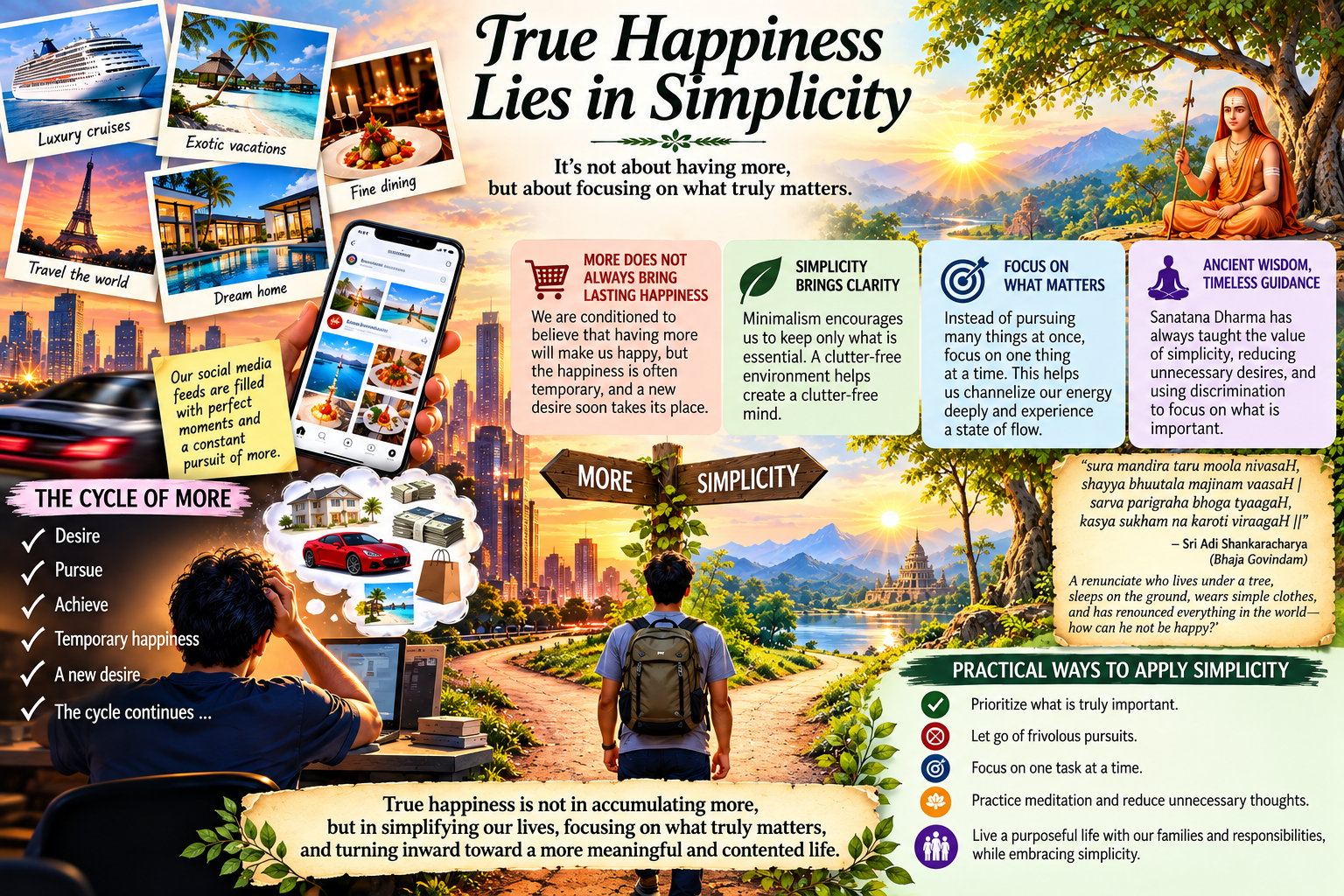
Open our social media profiles, and our feeds are filled with curated moments from friends sharing their perfect experiences—a luxury cruise, a vacation by the beach, travel to exotic places, meals at Michelin-starred restaurants, and so on. Look around us, and much of the world seems to be engaged in the same pursuit of more. More money, more comforts, more luxury.
We have been conditioned to associate having more with being happy. But when we look around us, we realize that luxury does not always bring lasting happiness. Let us say we wanted to purchase our dream home and saved for years to realize that dream. Finally, after a long and tedious search lasting several months, we find the home and buy it. The happiness we experience may last only until we get the keys and enter the home. Within a few days, that happiness is replaced by a different desire and its pursuit. Thus, the vicious cycle continues. So, if owning more does not bring lasting happiness, then what does?
The answer might lie at the other end of the spectrum: simplicity.
Minimalism is a concept that originated in the Orient and encourages owning only what is essential. Our environment has an impact on our mind, and therefore, decluttering our physical space can also help declutter our mind. Decluttering the mind involves reflecting on our priorities and pursuing only a handful of things that actually add meaning or value to our lives.
The idea is pretty simple. If we have ten different things to pursue, the time, effort, and attention we give to each of those pursuits will be dissipated. Whereas, if we focus on only one thing at a time, we can channelize all our energy into it.
Research has shown that people who work in a flow state feel more content. Humans are not cut out for multitasking. When we constantly switch between tasks, we dissipate a lot of our energy and are unable to focus deeply. Instead, if we take up one task and focus all our effort on it, we can reach a deep state of flow. People who work in a flow state tend to feel more content.
While this concept may feel new to the Western world, it is not new to Sanatana Dharma. Sri Patanjali, who gave us the Yoga Sutras and showed us a path to realization through Yoga, clearly states that one should reduce the number of thoughts. When we indulge each of our senses and pursue everything that we perceive through them, we only multiply our thoughts. How can we then reduce our thoughts? Using the powers of discretion to understand what is important and focusing only on that.
In Sanatana Dharma, the ultimate purpose of life is Self-realization. Those who pursue this goal by renouncing worldly life and taking up sannyasa (the life of a renunciate) are expected to live minimally and have no possessions, as this will help they stay focused in their goal. In Bhaja Govindam, Sri Adi Shankaracharya elucidates how a renunciate finds happiness and profound peace by living a life of simplicity with vairagya (dispassion):
“sura mandira taru moola nivasaH, shayya bhuutala majinam vaasaH |
sarva parigraha bhoga tyaagaH, kasya sukham na karoti viraagaH ||”
A renunciate who lives under a tree, sleeps on the ground, wears simple clothes, and has renounced everything in the world—how can he not be happy?
Yet, we are not all renunciates. We have our families, work, communities, and other responsibilities. But we can learn from Sanatana Dharma and apply these principles to our own lives. We can learn to prioritize what is important, use our rational mind to discard frivolous pursuits, and focus on our goals. This, indeed, can lead us to a more content and happy life.